.cb-root{
–ink:#2B2E33;
–ink-soft:#5B5F66;
–paper:#F3F2ED;
–paper-raised:#FFFFFF;
–line:#DEDCD3;
–sage:#6B7F76;
–sage-dark:#4F5F58;
–sage-bg:#EAEEEC;
–clay:#A85D45;
–clay-bg:#F3E7E2;
–water:#3E6E8E;
–water-bg:#E6EEF2;
}
.cb-root *{ box-sizing:border-box; }
.cb-root{ margin:0; background:var(–paper); color:var(–ink); font-family:’Inter’,-apple-system,sans-serif; font-size:16.5px; line-height:1.72; }
.cb-wrap{ max-width:820px; margin:0 auto; padding:0 22px 50px; }
.cb-root h1,.cb-root h2,.cb-root h3{ font-family:’Fraunces’,Georgia,serif; color:var(–ink); margin:0; }
.cb-root a{ color:var(–sage-dark); }
.cb-root p{ margin:0 0 15px; }
.cb-header-band{ background:var(–ink); color:var(–paper); padding:44px 0 30px; }
.cb-header-band .cb-eyebrow{ font-family:’JetBrains Mono’,monospace; font-size:11.5px; letter-spacing:0.18em; text-transform:uppercase; color:#B7C4BE; margin-bottom:14px; }
.cb-header-band h1{ font-size:clamp(25px,4.6vw,40px); font-weight:600; line-height:1.22; color:#fff; margin-bottom:14px; max-width:680px; }
.cb-header-band p.cb-lede{ color:#C7C9C6; font-size:16.5px; max-width:640px; margin-bottom:0; }
.cb-grout-strip{ height:8px; display:flex; }
.cb-grout-strip span{ flex:1; border-right:2px solid var(–paper); }
.cb-grout-strip span:last-child{ border-right:none; }
.cb-root h2{ font-size:25px; font-weight:600; margin:48px 0 14px; padding-bottom:10px; border-bottom:2px solid var(–ink); }
.cb-root h3{ font-size:19px; font-weight:600; margin:24px 0 8px; }
.cb-quick-answer{ background:var(–water-bg); border-left:4px solid var(–water); border-radius:4px; padding:16px 18px; margin:24px 0; }
.cb-quick-answer p{ margin:0; font-size:15.5px; color:#294456; }
.cb-quick-answer p+p{ margin-top:10px; }
.cb-quick-answer p strong{ color:var(–ink); }
.cb-tagrow{ display:flex; gap:8px; flex-wrap:wrap; margin:16px 0 8px; }
.cb-tag{ font-family:’JetBrains Mono’,monospace; font-size:11px; letter-spacing:0.06em; text-transform:uppercase; border:1px solid var(–ink); color:var(–ink); padding:4px 9px; border-radius:3px; }
/* ———- scale bars ———- */
.cb-scale-box{ margin:22px 0 8px; padding:22px 20px 18px; background:var(–paper-raised); border:1px solid var(–line); border-radius:8px; }
.cb-scale-row{ display:flex; align-items:center; gap:14px; margin-bottom:14px; }
.cb-scale-row:last-child{ margin-bottom:0; }
.cb-scale-label{ width:190px; flex-shrink:0; font-size:14px; font-weight:600; }
.cb-scale-track{ flex:1; height:14px; background:var(–sage-bg); border-radius:7px; overflow:hidden; }
.cb-scale-fill{ height:100%; background:var(–water); border-radius:7px; }
.cb-scale-fill.clay{ background:var(–clay); }
.cb-scale-val{ width:190px; flex-shrink:0; font-family:’JetBrains Mono’,monospace; font-size:12px; color:var(–ink-soft); text-align:right; }
.cb-scale-note{ font-family:’JetBrains Mono’,monospace; font-size:11.5px; color:var(–ink-soft); margin-top:14px; }
/* ———- image blocks ———- */
.cb-img-block{ margin:22px 0; border-radius:8px; overflow:hidden; border:1px solid var(–line); }
.cb-img-block img{ width:100%; height:320px; object-fit:cover; display:block; }
.cb-img-caption{ font-family:’JetBrains Mono’,monospace; font-size:11.5px; color:var(–ink-soft); padding:9px 12px; background:var(–paper-raised); border-top:1px solid var(–line); }
.cb-img-suggest{ margin:22px 0; border:1px dashed var(–water); border-radius:8px; padding:16px 18px; background:var(–water-bg); }
.cb-img-suggest-label{ font-family:’JetBrains Mono’,monospace; font-size:11px; letter-spacing:0.08em; text-transform:uppercase; color:var(–water); font-weight:600; margin-bottom:6px; }
.cb-img-suggest p{ margin:0; font-size:14px; color:#294456; }
/* ———- entry blocks ———- */
.cb-block{ margin-top:36px; padding-top:22px; border-top:1px dashed var(–line); }
.cb-block:first-of-type{ margin-top:20px; padding-top:0; border-top:none; }
.cb-block-head{ display:flex; align-items:baseline; gap:12px; margin-bottom:4px; }
.cb-block-num{ font-family:’JetBrains Mono’,monospace; font-size:13px; color:var(–clay); border:1px solid var(–clay); border-radius:3px; padding:2px 7px; flex-shrink:0; }
.cb-block h3{ margin:0; }
.cb-block-tag{ display:inline-block; font-family:’JetBrains Mono’,monospace; font-size:10.5px; text-transform:uppercase; letter-spacing:0.05em; background:var(–sage-bg); color:var(–sage-dark); padding:3px 8px; border-radius:3px; margin:6px 0 10px; }
.cb-block-tag.clay{ background:var(–clay-bg); color:var(–clay); }
.cb-block-specs{ font-family:’JetBrains Mono’,monospace; font-size:12px; color:var(–ink-soft); background:var(–paper-raised); border-left:3px solid var(–sage); padding:8px 12px; margin:10px 0 12px; }
.cb-block-specs span{ display:block; margin-bottom:2px; }
.cb-block-specs span:last-child{ margin-bottom:0; }
.cb-group-label{ font-family:’JetBrains Mono’,monospace; font-size:12px; letter-spacing:0.1em; text-transform:uppercase; color:var(–water); background:var(–water-bg); display:inline-block; padding:6px 12px; border-radius:4px; margin:34px 0 4px; }
.cb-table-wrap{ overflow-x:auto; border:1px solid var(–line); border-radius:6px; margin:16px 0; }
.cb-table{ width:100%; border-collapse:collapse; font-size:14px; min-width:600px; }
.cb-table th{ background:var(–ink); color:#fff; text-align:left; padding:10px 12px; font-family:’JetBrains Mono’,monospace; font-size:10px; letter-spacing:0.04em; text-transform:uppercase; }
.cb-table td{ padding:9px 12px; border-bottom:1px solid var(–line); }
.cb-table tr:nth-child(even) td{ background:#FAFAF7; }
.cb-table td:first-child{ font-weight:600; }
.cb-tip-list{ display:flex; flex-direction:column; gap:10px; margin:18px 0; }
.cb-tip-list .item{ display:flex; gap:12px; align-items:flex-start; }
.cb-tip-list .dot{ width:8px; height:8px; border-radius:50%; background:var(–sage-dark); margin-top:8px; flex-shrink:0; }
.cb-tip-list .txt strong{ display:block; font-size:15px; margin-bottom:2px; }
.cb-tip-list .txt p{ margin:0; font-size:14.5px; color:var(–ink-soft); }
.cb-mistake-list{ display:flex; flex-direction:column; gap:12px; margin:18px 0; }
.cb-mistake-list .item{ display:flex; gap:14px; background:var(–paper-raised); border:1px solid var(–line); border-radius:6px; padding:14px 16px; }
.cb-mistake-list .num{ font-family:’Fraunces’,serif; font-weight:600; font-size:22px; color:var(–clay); flex-shrink:0; line-height:1.3; }
.cb-mistake-list .txt strong{ display:block; font-size:15.5px; margin-bottom:3px; }
.cb-mistake-list .txt p{ margin:0; font-size:14.5px; color:var(–ink-soft); }
.cb-faq-item{ border-top:1px solid var(–line); padding:18px 0; }
.cb-faq-item:last-child{ border-bottom:1px solid var(–line); }
.cb-faq-item .q{ font-family:’Fraunces’,serif; font-weight:600; font-size:17px; margin-bottom:6px; }
.cb-faq-item .a{ font-size:15px; margin:0; color:var(–ink-soft); }
@media (max-width:600px){ .cb-scale-label{ width:110px; } .cb-scale-val{ width:100px; } .cb-img-block img{ height:220px; } }
Living Room Decor Guide · Updated 2026
Living Room Vase Decor Ideas
Most “vase decor” roundups are a photo gallery with a caption underneath each one. Here’s the actual sizing math, the placement-specific ideas, and the mistakes that quietly make an otherwise good vase look wrong.

A vase is one of the few pieces of living room decor you can move, refill, and restyle in under a minute, and yet most people buy exactly one and never touch it again. Scroll through most “living room vase ideas” articles and the advice reads the same way for a coffee table, a console, and a bare floor corner, even though each surface actually calls for a different size, a different grouping, and often a different material entirely.
This guide is organized by where the vase actually goes, not just by style photos. It covers coffee tables, console tables, shelves, mantels, and floors individually, plus the size chart and the mistake list that most roundups skip over completely.
Quick answer: Match the vase to the surface, not the other way around. Coffee table vases stay under 14 inches so they don’t block sightlines across the table; console and mantel vases can run 14 to 22 inches; a floor vase works best at roughly a third to half the height of whatever furniture it sits beside, usually 24 to 40 inches in an average living room. Group vases in odd numbers at different heights, and repeat a color that’s already in the room instead of buying one to match it exactly. The single biggest mistake isn’t the vase itself, it’s forgetting that at least one of them should be left empty.
Why Proportion Is the Rule Everyone Skips
A vase is small enough that it’s easy to treat as an afterthought, something picked up on a store run and set down wherever there’s a gap. But scale is exactly why some living rooms look styled and others look like they have random objects sitting on every flat surface. The same vase that anchors an empty corner disappears on a console table, and the pair that looks right flanking a mirror on a mantel looks stiff and overly matched on a bookshelf.
Different surfaces also call for different math. A coffee table vase has to stay low enough that it doesn’t block a conversation across the table. A floor vase has the opposite problem: too short, and it reads as an accident rather than a choice. The ideas in this guide are organized by surface for that reason, since the right vase for a shelf is rarely the right vase for an empty corner of the floor.
Odd numbers over matched pairs
Empty is a valid choice
Vase Size by Placement
A rough height range for each spot covered in this guide. These are starting points, not fixed rules, a larger, open-plan room can usually handle the top of each range, and a smaller room or lower ceiling looks better nearer the bottom.
Bar length shows relative height, not any other measure. A floor vase is roughly five times the height of a small bud vase, which is exactly why the two need completely different fillers.

Vase Materials Compared
Material sets the tone of a room more than most people expect, and it also decides which fillers actually work in it.
| Material | Best for | Best filler | Upkeep |
|---|---|---|---|
| Glass | Modern, contemporary, minimalist | Fresh flowers | Needs regular water changes; shows the stems |
| Ceramic / stoneware | Almost any style | Anything | Lowest upkeep, most versatile material |
| Terracotta | Farmhouse, boho, coastal | Dried grasses, branches | Not watertight; best kept dry |
| Metal | Industrial, glam, minimalist | Dried or faux stems | Can water-spot inside; pair with dry filler |
| Wood / rattan | Boho, coastal, Scandinavian | Dried stems only | Not watertight at all |
Living Room Vase Decor Ideas by Placement
Ten ideas, grouped by the surface they’re built for, each with the size or filler detail that makes it actually work.
A Single Low, Wide Vase
Coffee table default
A low, wide vase with a loose bunch of one flower type holds up as a lone centerpiece as long as the rest of the table stays clear. It’s the simplest option on this list and still the one that works in almost any living room.
A Trio of Bud Vases
Adds color without bulk
A trio of narrow bud vases, each with a single stem, spreads color across the table without adding bulk, and it works especially well on a long, rectangular coffee table where one vase alone can look lost.
A Tall-and-Short Pairing on a Console
Breaks up console symmetry
A tall, slim vase on one end of a console table, balanced by a shorter cluster on the other end, reads as more current than two identical vases bookending the table.
Matched Mantel Pairs
The one spot symmetry wins
Two identical vases, one on each end of the mantel, with a clock, mirror, or art in the middle, is a classic look that hasn’t gone out of style. A mantel is usually the most symmetrical spot in the room already, so a matched pair fits it better than it fits anywhere else.
A Statement Floor Vase in an Empty Corner
Fixes bare corners
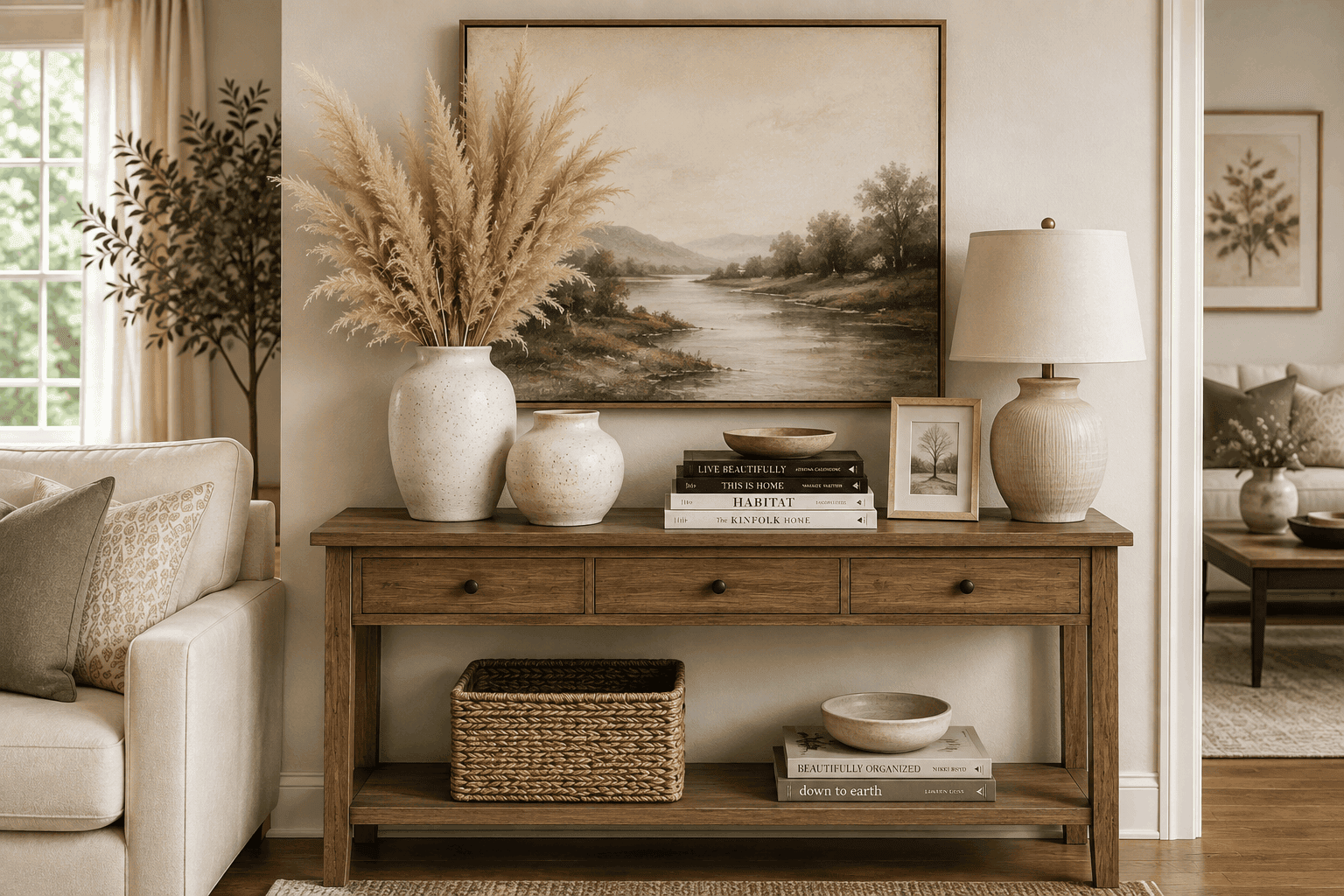
An empty corner is the fastest problem a floor vase solves. Fill it with stems that reach a little above the rim, pampas grass, dried branches, or tall faux greenery, rather than stopping the arrangement flush with the opening.
A Floor Vase Beside a Sofa Arm
Closes an awkward gap
The gap between a sofa arm and the wall is one of the most common dead zones in a living room, and a floor vase fills it without adding another piece of furniture to work around.
A Vase Used as a Bookend
Does double duty
A vase set at the end of a row of books gives it a job beyond decoration, and it keeps the shelf from looking too deliberately styled the way a full lineup of decorative objects can.
One Empty Vase Per Shelf
Costs nothing to try
An empty vase, left deliberately bare on a shelf that otherwise holds books or framed photos, gives the whole bookcase a place for the eye to rest instead of landing on every shelf at once.
Dried Pampas Grass Instead of Fresh Flowers
No water, no upkeep
Pampas grass fills a large vase quickly and has enough texture to look intentional even with just a handful of stems, and unlike fresh flowers, it holds up for months without any attention at all.
Rotate the Filler, Not the Vase
One vase, four seasons
Swapping what’s inside a vase, rather than buying a new one every season, is the easiest way to keep a living room feeling current without redecorating on a schedule.

Seasonal Vase Fillers at a Glance
Swapping the filler, not the vase, is the easiest way to keep a living room feeling current through the year.
| Season | Filler | Vase pairing |
|---|---|---|
| Spring | Tulips, daffodils, cherry blossom branches | Clear glass, light ceramic |
| Summer | Hydrangeas, sunflowers, loose garden bunch | Brighter or more colorful vase |
| Fall | Pampas grass, dried wheat, turning branches | Terracotta, amber glass |
| Winter | Pine, evergreen, bare white branches | Metallic vase |
| Holidays | Small ornaments, pinecones | Clear glass, everyday vase |
Vase Decorating Mistakes to Avoid
A single vase moved between the coffee table, a shelf, and the mantel usually ends up wrong in all three spots, since each surface calls for a different height and shape.
Dead-center placement on a coffee table or console can look stiff. Off to one side, or grouped with one or two other objects, almost always looks more natural.
A vase in the exact same color as the room around it tends to disappear rather than stand out. Echo a color from elsewhere in the room instead of matching the biggest surface in it.
A tiny bud vase alone on a large console looks lost, and an oversized floor vase in a small nook overwhelms the space around it.
Three vases of identical height read as a matched set rather than a curated display. Vary the height, even slightly, across any grouping of two or more.
A wilting arrangement undercuts an otherwise well-styled vase faster than almost anything else on this list. A dried or faux filler holds up better if refreshing water isn’t realistic.
A room where every vase is stuffed with flowers or greenery starts to feel busy. Leaving at least one vase empty gives the eye somewhere to rest.
Combining glass, metal, and ceramic in one grouping can look intentional or look random, and the difference usually comes down to repeating at least one color or material across the pieces.
The Rules That Actually Work
Aim for a vase somewhere between a third and two-thirds the height of whatever it sits next to, a sofa arm, a stack of books, the wall space above it.
Three vases at different heights read as considered. Two identical vases read as matched furniture, symmetry has its place on a mantel, but not everywhere.
Pick a shade that already shows up elsewhere in the room, a pillow, a rug, a piece of art, so the vase feels connected rather than dropped in.
Pairing a matte vase with a glossy one, or smooth glass with rough terracotta, gives the eye something to catch on instead of a flat, uniform display.
A vase with an interesting shape or finish can stand on its own as a small sculpture, and an empty one gives a grouping room to breathe.

Vase Colors for Every Living Room Palette
| Color | Best for | Note |
|---|---|---|
| White | Any room, safest first purchase | Reads as sculptural, pairs with any filler or style |
| Black | Rooms with light, neutral palettes | Acts as an anchor point, like a piece of dark-framed art |
| Neutral / earth tones | Multi-vase groupings | Lets the grouping or filler be the focal point, not the vase |
| Bold single color | One accent piece, not several | Repeat a shade already present somewhere else in the room |
For a modern living room specifically, matte white, matte black, and warm neutral stoneware are the three safest choices, since all three age well and don’t tie the room to a color scheme you might want to change in a year or two.
Frequently Asked Questions
How do you decorate a vase in the living room?
Start by picking one placement, coffee table, console, shelf, or floor, and match the vase height to that surface using the size chart above. From there, either fill it with flowers, dried stems, or branches, or leave it empty if the room already has enough going on.
What should I put inside a decorative vase?
Fresh flowers, dried stems like pampas grass or eucalyptus, faux branches, or nothing at all. An empty vase with an interesting shape or finish works as its own piece of decor.
Where should a vase be placed in the living room?
The most common spots are the coffee table, a console or sofa table, open shelves, a mantel, and the floor beside furniture or in an empty corner. Pick a spot where the vase fills an actual visual gap, not one that blocks a walking path or a window.
What type of vase is best for a living room?
It depends on the room’s existing materials more than any fixed rule. Glass and metal suit modern or minimalist rooms; ceramic and stoneware work in almost any style; terracotta and woven vases fit farmhouse, boho, and coastal rooms. A matte ceramic vase in a neutral color is the safest first purchase.
How many vases should you decorate with?
Odd numbers, one, three, or five, tend to look more natural than even numbers, since even groupings can look overly matched. A single large vase works well as a standalone statement piece; groups of three at varied heights suit shelves, consoles, or mantels.
How do you style a large floor vase?
Choose a vase roughly a third to half the height of whatever it sits beside, then fill it with stems that reach a little above the rim rather than stopping flush. Place it somewhere genuinely empty, a bare corner or beside a sofa arm, and leave enough floor space around it that it doesn’t become a walking hazard.
What flowers look best in decorative vases?
Tulips, hydrangeas, peonies, and ranunculus hold their shape well in fresh arrangements. For something lower-maintenance, dried or faux pampas grass and eucalyptus last for months and still look intentional.
Can you decorate with empty vases?
Yes. A vase with a strong shape, an unusual glaze, ribbed texture, or asymmetrical silhouette, works as sculpture on its own and often looks more deliberate than one packed with filler, especially in minimalist or modern rooms.
What color vase goes with a modern living room?
Matte white, matte black, and warm neutral stoneware are the safest choices, since all three read as sculptural rather than decorative. A single vase in a saturated color also works as an accent, as long as it repeats a shade already present in the room.
How do you decorate a coffee table with a vase?
Keep the vase under about 14 inches so it doesn’t block sightlines across the table, and place it off-center rather than in the exact middle. Pairing it with one or two other objects, a tray, a candle, a stack of books, usually looks more intentional than the vase sitting alone.
Final Thoughts
The living rooms that look effortlessly styled usually aren’t working with more vases, just better-matched ones. A single vase sized correctly for its surface does more than three mismatched ones spread across the room. Start with one spot, a coffee table, a console, or that one empty corner, match it against the chart above, and let the rest of the room follow from there.
Leave a Reply