:root{
–ink:#2B2E33;
–ink-soft:#5B5F66;
–paper:#F3F2ED;
–paper-raised:#FFFFFF;
–line:#DEDCD3;
–sage:#6B7F76;
–sage-dark:#4F5F58;
–sage-bg:#EAEEEC;
–clay:#A85D45;
–clay-bg:#F3E7E2;
–water:#3E6E8E;
–water-bg:#E6EEF2;
}
*{ box-sizing:border-box; }
body{ margin:0; background:var(–paper); color:var(–ink); font-family:’Inter’,-apple-system,sans-serif; font-size:16.5px; line-height:1.72; }
.wrap{ max-width:820px; margin:0 auto; padding:0 22px 50px; }
h1,h2,h3{ font-family:’Fraunces’,Georgia,serif; color:var(–ink); margin:0; }
.mono{ font-family:’JetBrains Mono’,monospace; }
a{ color:var(–sage-dark); }
p{ margin:0 0 15px; }
.header-band{ background:var(–ink); color:var(–paper); padding:44px 0 30px; }
.header-band .eyebrow{ font-family:’JetBrains Mono’,monospace; font-size:11.5px; letter-spacing:0.18em; text-transform:uppercase; color:#B7C4BE; margin-bottom:14px; }
.header-band h1{ font-size:clamp(26px,5vw,40px); font-weight:600; line-height:1.2; color:#fff; margin-bottom:14px; max-width:680px; }
.header-band p.lede{ color:#C7C9C6; font-size:16.5px; max-width:640px; margin-bottom:0; }
.grout-strip{ height:8px; display:flex; }
.grout-strip span{ flex:1; border-right:2px solid var(–paper); }
.grout-strip span:last-child{ border-right:none; }
h2{ font-size:26px; font-weight:600; margin:48px 0 14px; padding-bottom:10px; border-bottom:2px solid var(–ink); }
h3{ font-size:19px; font-weight:600; margin:24px 0 8px; }
/* ———- quick answer box ———- */
.quick-answer{ background:var(–water-bg); border-left:4px solid var(–water); border-radius:4px; padding:16px 18px; margin:24px 0; }
.quick-answer p{ margin:0; font-size:15.5px; color:#294456; }
.quick-answer p strong{ color:var(–ink); }
/* ———- water resistance scale (signature element) ———- */
.wr-scale{ margin:22px 0 8px; padding:22px 20px 18px; background:var(–paper-raised); border:1px solid var(–line); border-radius:8px; }
.wr-row{ display:flex; align-items:center; gap:14px; margin-bottom:14px; }
.wr-row:last-child{ margin-bottom:0; }
.wr-label{ width:150px; flex-shrink:0; font-size:14px; font-weight:600; }
.wr-track{ flex:1; height:14px; background:var(–sage-bg); border-radius:7px; overflow:hidden; }
.wr-fill{ height:100%; background:var(–water); border-radius:7px; }
.wr-pct{ width:76px; flex-shrink:0; font-family:’JetBrains Mono’,monospace; font-size:12px; color:var(–ink-soft); text-align:right; }
.wr-note{ font-family:’JetBrains Mono’,monospace; font-size:11.5px; color:var(–ink-soft); margin-top:14px; }
/* ———- pros/cons ———- */
.pc-grid{ display:grid; grid-template-columns:1fr 1fr; gap:16px; margin:18px 0; }
@media (max-width:640px){ .pc-grid{ grid-template-columns:1fr; } }
.pc-grid .pros, .pc-grid .cons{ padding:16px 18px; border-radius:6px; }
.pc-grid .pros{ background:var(–sage-bg); border:1px solid #C9D4CE; }
.pc-grid .cons{ background:var(–clay-bg); border:1px solid #E3C7BB; }
.pc-grid p.lbl{ font-family:’JetBrains Mono’,monospace; font-size:11px; text-transform:uppercase; letter-spacing:0.06em; font-weight:700; margin:0 0 10px; }
.pc-grid .pros p.lbl{ color:var(–sage-dark); }
.pc-grid .cons p.lbl{ color:var(–clay); }
.pc-grid ul{ margin:0; padding-left:18px; font-size:14.5px; }
.pc-grid li{ margin-bottom:6px; }
/* ———- comparison table ———- */
.table-wrap{ overflow-x:auto; border:1px solid var(–line); border-radius:6px; margin:16px 0; }
table.compare{ width:100%; border-collapse:collapse; font-size:14px; min-width:640px; }
table.compare th{ background:var(–ink); color:#fff; text-align:left; padding:10px 12px; font-family:’JetBrains Mono’,monospace; font-size:10px; letter-spacing:0.04em; text-transform:uppercase; }
table.compare td{ padding:9px 12px; border-bottom:1px solid var(–line); }
table.compare tr:nth-child(even) td{ background:#FAFAF7; }
table.compare td:first-child{ font-weight:600; }
/* ———- brand cards ———- */
.brand-grid{ display:flex; flex-direction:column; gap:12px; margin:18px 0; }
.brand-grid .item{ background:var(–paper-raised); border:1px solid var(–line); border-radius:6px; padding:14px 16px; }
.brand-grid .item strong{ display:block; font-size:15.5px; margin-bottom:4px; }
.brand-grid .item p{ margin:0; font-size:14.5px; color:var(–ink-soft); }
/* ———- mistake list ———- */
.mistake-list{ display:flex; flex-direction:column; gap:12px; margin:18px 0; }
.mistake-list .item{ display:flex; gap:14px; background:var(–paper-raised); border:1px solid var(–line); border-radius:6px; padding:14px 16px; }
.mistake-list .num{ font-family:’Fraunces’,serif; font-weight:600; font-size:22px; color:var(–clay); flex-shrink:0; line-height:1.3; }
.mistake-list .txt strong{ display:block; font-size:15.5px; margin-bottom:3px; }
.mistake-list .txt p{ margin:0; font-size:14.5px; color:var(–ink-soft); }
/* ———- expert tips ———- */
.tip-list{ display:flex; flex-direction:column; gap:10px; margin:18px 0; }
.tip-list .item{ display:flex; gap:12px; align-items:flex-start; }
.tip-list .dot{ width:8px; height:8px; border-radius:50%; background:var(–sage-dark); margin-top:8px; flex-shrink:0; }
.tip-list .txt strong{ display:block; font-size:15px; margin-bottom:2px; }
.tip-list .txt p{ margin:0; font-size:14.5px; color:var(–ink-soft); }
/* ———- FAQ ———- */
.faq-item{ border-top:1px solid var(–line); padding:18px 0; }
.faq-item:last-child{ border-bottom:1px solid var(–line); }
.faq-item .q{ font-family:’Fraunces’,serif; font-weight:600; font-size:17px; margin-bottom:6px; }
.faq-item .a{ font-size:15px; margin:0; color:var(–ink-soft); }
Bathroom Flooring Guide · Updated 2026
Can You Put Laminate in a Bathroom? The Honest Answer
Standard laminate and bathroom moisture don’t mix well, but the newer waterproof and water-resistant lines change that answer. Here’s what actually holds up, and what doesn’t.
Search “can you put laminate in a bathroom” and you’ll get answers ranging from a flat no to an enthusiastic yes, often from the same website. The honest answer sits in between: it depends entirely on which laminate you mean, since the category now spans old-style fiberboard planks that swell if a towel drips on them, all the way up to genuinely waterproof rigid-core products that can handle a real spill without damage.
Quick answer: standard laminate flooring is not a good fit for a bathroom. Waterproof or water-resistant laminate, installed with sealed seams and a moisture-rated underlayment, can work in a low-moisture bathroom, but vinyl plank and tile remain more reliable choices for a shower-adjacent floor.
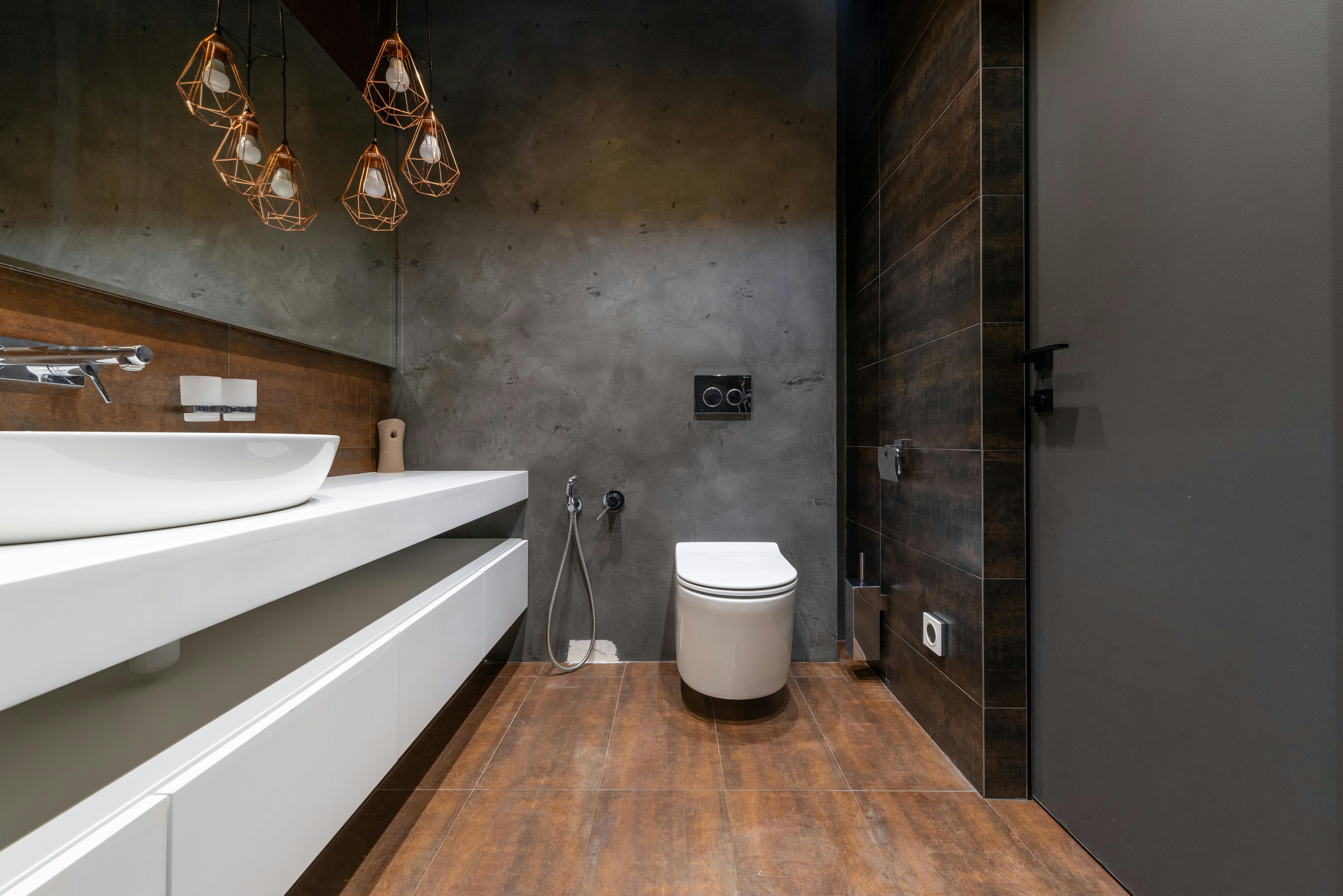
Can You Put Laminate Flooring in a Bathroom?
Yes, but with real conditions attached. Laminate flooring is built from a high-density fiberboard (HDF) core, a printed design layer, and a clear wear layer on top. That HDF core is essentially compressed wood fiber, and wood fiber absorbs water. Standard laminate swells, warps, or delaminates at the seams if water sits on it for more than a few minutes, which makes a bathroom, where standing water is a matter of when, not if, a genuinely risky environment for it.
What’s changed is the arrival of laminate specifically engineered for wet rooms: sealed edges, water-repellent core treatments, and tighter click-lock joints that resist water infiltration at the seams. That version of bathroom laminate flooring can hold up in a powder room or a bathroom with a separate shower stall, where splashing is occasional rather than constant.
Is Laminate Flooring Waterproof?
Mostly, no, not in the way vinyl or tile are. This is the point where a lot of marketing gets loose with the word “waterproof,” so it’s worth being precise. Traditional laminate is water-resistant at best: it can handle a spill wiped up promptly, but standing water for hours will eventually reach the HDF core through the seams.
Genuinely waterproof flooring uses a rigid core made from SPC (stone plastic composite) or WPC (wood plastic composite), materials that don’t absorb water at all. Some flooring brands market SPC and WPC rigid-core planks under the “waterproof laminate” name because they look and click together like laminate, but technically they’re closer to luxury vinyl plank in construction. True wood-fiber laminate, even the best water-resistant versions, is rated to survive spills for a bounded window of time, commonly 24 to 72 hours depending on the product, not permanent exposure.
Relative water resistance by flooring category, not a specific product rating.
Does laminate flooring swell when wet? Yes, that’s the core failure mode. Water gets into the seams, the HDF core absorbs it, and the boards expand, often visibly bowing or lifting at the joints. What happens if laminate flooring gets wet depends on how long it sits: a splash wiped up in a minute or two on quality laminate usually causes no lasting damage, while standing water left overnight almost always causes swelling that isn’t reversible.
Pros and Cons of Laminate Flooring in Bathrooms
Pros
- Costs a fraction of tile or natural stone
- Click-lock installation is DIY-friendly, no adhesive or grout required
- Wide range of wood-look and stone-look styles
- Comfortable underfoot compared to tile or stone
- Easy to sweep and mop, no grout lines to scrub
Cons
- Standard laminate swells and warps if water reaches the core
- Damaged sections usually need full plank replacement, not a patch
- Can feel slippery when wet, especially smooth finishes
- Expands and contracts with humidity and temperature swings
- Water damage isn’t covered under most standard warranties
Laminate vs Vinyl Flooring for Bathrooms
Is vinyl better than laminate for bathrooms? For a true wet area, yes. Vinyl plank, especially rigid SPC or WPC core versions, is fully waterproof straight through the plank, not just at a treated surface layer, so there’s no core to swell even if water sits for an extended period. Laminate, even the water-resistant versions, is still a wood-fiber product underneath its coatings.
| Factor | Laminate Flooring | Vinyl Flooring |
|---|---|---|
| Water resistance | Low to moderate | High to fully waterproof |
| Core material | HDF (wood fiber) | PVC, SPC, or WPC |
| Feel underfoot | Firm, slightly harder | Softer, warmer |
| Repair if damaged | Replace the plank | Replace the plank |
| Typical cost | Low to moderate | Low to moderate |
| Best for | Powder rooms, low-splash areas | Full bathrooms, shower-adjacent floors |
Best Waterproof Laminate Flooring Options
A handful of established flooring brands make water-resistant laminate lines specifically positioned for kitchens and bathrooms. Availability and exact specifications change often, so confirm current warranty terms directly with the manufacturer before buying, but these are the names most consistently associated with wet-area laminate:
Pergo’s Outlast+ and WetProtect lines are built around sealed, water-repellent cores aimed specifically at kitchens and bathrooms, with spill protection rated in hours rather than being marketed as fully submersion-proof.
Mohawk’s RevWood and RevWood Plus collections use a water-resistant core and a sealed joint system, marketed for moisture-prone rooms alongside a residential warranty covering that performance.
Mannington’s SpillShield technology focuses on protecting the surface and seams from spills long enough to clean them up, paired with NALFA-certified testing for durability.
A long-established European laminate brand with water-resistant collections designed around tighter click-lock joints to slow moisture penetration at the seams.
A note on marketing claims: treat any listing claiming a laminate is “100% waterproof” with some skepticism. If the core material is genuinely SPC or WPC rather than HDF, it’s technically a rigid vinyl product regardless of what it’s labeled, and that’s worth confirming before you buy for a bathroom specifically.
How to Protect Laminate Flooring from Moisture
A vapor barrier underneath the planks blocks moisture from below, which matters as much as protecting the surface.
Silicone caulk around the perimeter, especially at the tub, toilet base, and vanity, stops water from wicking sideways into the core.
Reducing ambient humidity after a shower does more for the floor’s long-term condition than any single product choice.
Even fully water-resistant laminate is rated for a bounded window of exposure, not indefinite standing water.
A mat that stays damp against the floor for hours defeats the purpose of a water-resistant surface underneath it.
Common Mistakes to Avoid
Laminate without a water-resistant rating is the wrong product for a room with a shower or tub, regardless of price.
A basic foam underlayment doesn’t block moisture from below the way a vapor-barrier underlayment does.
These are the two spots water pools most often, and they’re the first place unsealed laminate fails.
These are different ratings with different real-world tolerances, and the difference matters most in the wettest room in the house.
Many laminate warranties explicitly exclude bathroom installations. Check before you buy, not after a claim gets denied.
Best Bathroom Flooring Alternatives
| Option | Water Resistance | Typical Cost | Best For |
|---|---|---|---|
| Vinyl plank (LVP/SPC) | Fully waterproof | Low to moderate | Full bathrooms, rentals, most budgets |
| Ceramic or porcelain tile | Fully waterproof | Moderate to high | Long-term durability, resale value |
| Natural stone | Waterproof when sealed | High | High-end, design-forward bathrooms |
| Engineered wood | Moderate | Moderate to high | Powder rooms with minimal splashing |
| Rubber flooring | Fully waterproof | Moderate | Slip resistance, comfort underfoot |
Expert Tips Before Installing Laminate
Ask specifically whether the core is HDF, SPC, or WPC before assuming a product is bathroom-ready.
A verbal “it’s waterproof” from a salesperson means nothing if the printed warranty excludes bathrooms.
Some homeowners split the floor, vinyl directly around the tub and shower, laminate elsewhere in a larger bathroom.
Click-lock flooring of any kind performs worse over an uneven subfloor, which stresses the seams exactly where water gets in.
Frequently Asked Questions
Can laminate flooring be used in bathrooms?
Yes, but only water-resistant or waterproof-rated laminate, installed with sealed seams and a moisture-rated underlayment. Standard laminate is not recommended for a bathroom floor.
Is laminate flooring waterproof?
Most laminate is water-resistant, not fully waterproof. Genuinely waterproof flooring in this category typically has an SPC or WPC rigid core, which functions more like vinyl plank than traditional wood-fiber laminate.
Does laminate flooring swell when wet?
Standard laminate does, since its HDF core absorbs water that reaches it through the seams. Water-resistant laminate resists this for a longer window but isn’t immune to prolonged standing water.
What happens if laminate flooring gets wet?
A quick spill wiped up promptly usually causes no damage on quality laminate. Water left standing for hours typically causes the boards to swell, bow, or lift at the seams, and that damage isn’t reversible.
Can laminate flooring handle bathroom moisture?
Water-resistant laminate can handle occasional splashing and ambient humidity reasonably well. It’s not built to handle standing water around a tub or shower long-term the way vinyl or tile can.
Is vinyl better than laminate for bathrooms?
For a full bathroom with a shower or tub, yes. Vinyl’s core material doesn’t absorb water at all, while even water-resistant laminate has a wood-fiber core underneath its protective layers.
What is the best flooring for a bathroom?
Vinyl plank and ceramic or porcelain tile are generally the most reliable choices, since both are fully waterproof through the material itself, not just at a surface coating.
Can you use laminate flooring around a toilet?
Water-resistant laminate can work around a toilet in a low-splash area, but the seam where the floor meets the toilet base should be sealed with silicone caulk to block water from getting underneath.
How long does laminate flooring last in a bathroom?
Water-resistant laminate installed and sealed correctly can last 10 to 15 years in a low-moisture bathroom. Standard laminate in a full bathroom often shows swelling within a year or two of regular splashing.
Should you put laminate flooring in a bathroom?
In a powder room or a bathroom with minimal splashing, water-resistant laminate is a reasonable, budget-friendly choice. In a full bathroom with a shower or tub, vinyl or tile is the safer long-term option.
Leave a Reply