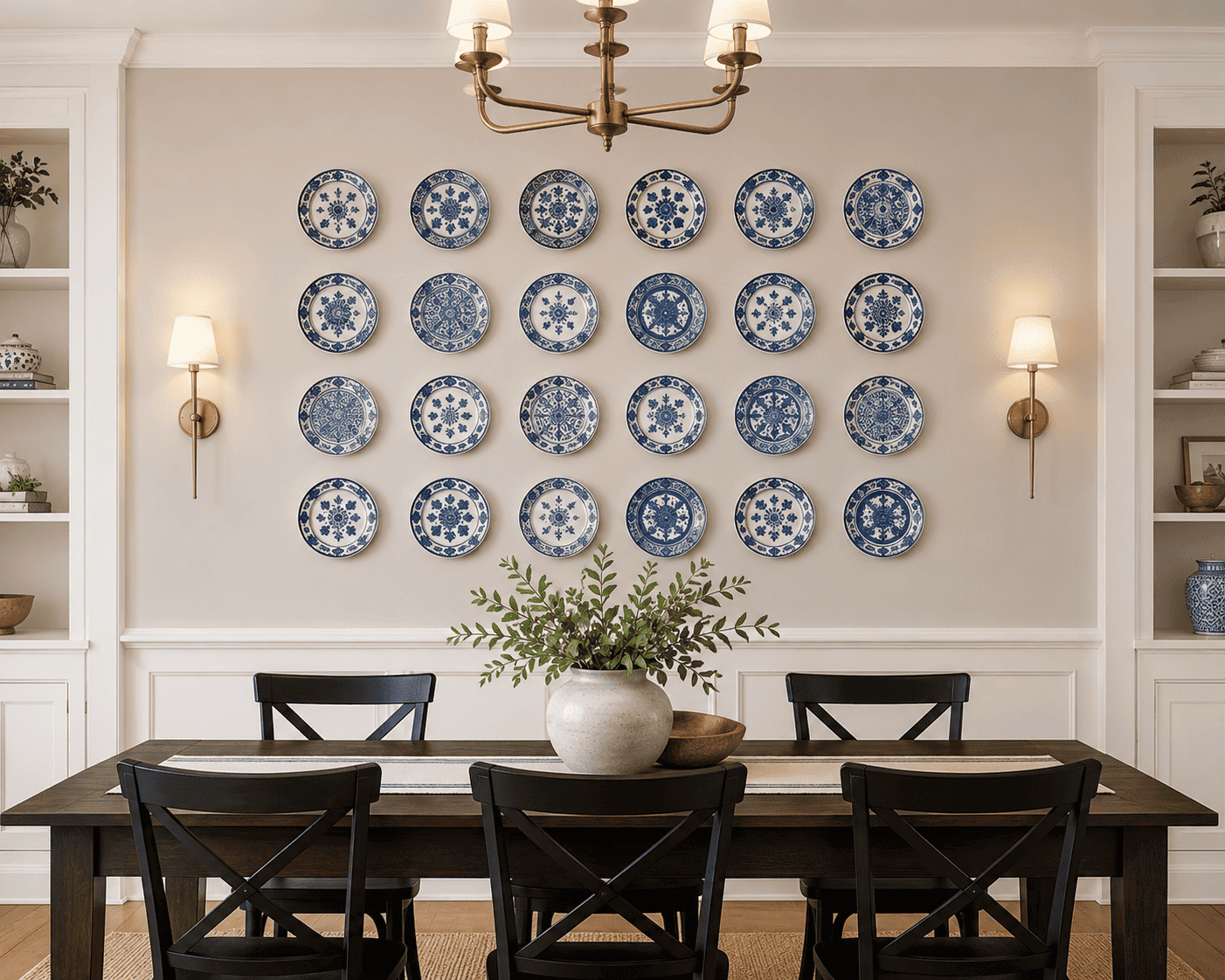

Most plate wall guides are really just photo roundups: a grid here, a circle there, a caption telling you it “adds texture.” What they skip is the part that actually determines whether your wall looks intentional or like something fell off a shelf: how much a plate hanger can actually hold, how far apart to space plates so the arrangement reads as one piece instead of scattered dots, and which layouts genuinely suit a narrow hallway versus a wide dining room wall.
This guide covers 20 distinct plate wall styles sorted by layout, color story, and room, plus the arrangement math, hanger weight ratings, and the honest mistakes that make a plate wall look cluttered instead of curated.
Quick answer: Space plates 2 to 3 inches apart for a cohesive look, and lay everything out on the floor (or trace paper templates and tape them to the wall) before you hang a single one. Small plates under 6 inches work fine on adhesive discs; anything over 10 inches or heavier than about 5 pounds needs a wire spring hanger or a wall anchor into a stud, not adhesive alone.
What Is a Plate Wall?
A plate wall is a wall display built from decorative or dinnerware-style plates mounted flat against the wall using hangers, rather than plates used for actual dining. It functions the same way a gallery wall of framed art does, filling vertical space with a curated collection, except the “art” is ceramic, porcelain, or occasionally metal or wood, and it carries texture and dimension a flat framed print can’t.
Why Plate Walls Are Trending in Home Decor
Plate walls sit at the intersection of two decorating trends that have both had staying power: the grandmillennial and cottagecore-adjacent revival of inherited and vintage china, and a broader shift toward decor that looks collected over time rather than bought as a matching set in one trip. A plate wall also solves a genuinely practical problem: heirloom china and thrifted platters that spend their lives in a cabinet get to actually be seen, and a large wall gets filled without the cost of buying a comparable amount of framed art.
20 Best Plate Wall Ideas for Every Room
Sorted into four groups: classic layouts, color and pattern stories, scale and focal-point approaches, and room-specific setups.
Group 1: Classic Layouts
01. Classic Symmetrical Grid

Beginner-friendly
Rows and columns of matching or same-sized plates, spaced identically in every direction. It’s the easiest layout to get right on a first attempt because the grid itself does the visual work, and it reads as intentional even with mismatched patterns as long as the sizing and spacing stay consistent.
- Best for: Dining rooms, large blank walls
- Difficulty: Easy
- Plate count: 6-12
Leave a Reply