.pw-root{
–ink:#2B2E33;
–ink-soft:#5B5F66;
–paper:#F3F2ED;
–paper-raised:#FFFFFF;
–line:#DEDCD3;
–sage:#6B7F76;
–sage-dark:#4F5F58;
–sage-bg:#EAEEEC;
–clay:#A85D45;
–clay-bg:#F3E7E2;
–water:#3E6E8E;
–water-bg:#E6EEF2;
}
.pw-root *{ box-sizing:border-box; }
.pw-root{ margin:0; background:var(–paper); color:var(–ink); font-family:’Inter’,-apple-system,sans-serif; font-size:16.5px; line-height:1.72; }
.pw-wrap{ max-width:820px; margin:0 auto; padding:0 22px 50px; }
.pw-root h1,.pw-root h2,.pw-root h3{ font-family:’Fraunces’,Georgia,serif; color:var(–ink); margin:0; }
.pw-root a{ color:var(–sage-dark); }
.pw-root p{ margin:0 0 15px; }
.pw-header-band{ background:var(–ink); color:var(–paper); padding:44px 0 30px; }
.pw-header-band .pw-eyebrow{ font-family:’JetBrains Mono’,monospace; font-size:11.5px; letter-spacing:0.18em; text-transform:uppercase; color:#B7C4BE; margin-bottom:14px; }
.pw-header-band h1{ font-size:clamp(25px,4.6vw,40px); font-weight:600; line-height:1.22; color:#fff; margin-bottom:14px; max-width:680px; }
.pw-header-band p.pw-lede{ color:#C7C9C6; font-size:16.5px; max-width:640px; margin-bottom:0; }
.pw-grout-strip{ height:8px; display:flex; }
.pw-grout-strip span{ flex:1; border-right:2px solid var(–paper); }
.pw-grout-strip span:last-child{ border-right:none; }
.pw-root h2{ font-size:25px; font-weight:600; margin:48px 0 14px; padding-bottom:10px; border-bottom:2px solid var(–ink); }
.pw-root h3{ font-size:19px; font-weight:600; margin:24px 0 8px; }
.pw-quick-answer{ background:var(–water-bg); border-left:4px solid var(–water); border-radius:4px; padding:16px 18px; margin:24px 0; }
.pw-quick-answer p{ margin:0; font-size:15.5px; color:#294456; }
.pw-quick-answer p+p{ margin-top:10px; }
.pw-quick-answer p strong{ color:var(–ink); }
.pw-tagrow{ display:flex; gap:8px; flex-wrap:wrap; margin:16px 0 8px; }
.pw-tag{ font-family:’JetBrains Mono’,monospace; font-size:11px; letter-spacing:0.06em; text-transform:uppercase; border:1px solid var(–ink); color:var(–ink); padding:4px 9px; border-radius:3px; }
.pw-hero-img{ margin:22px 0; border-radius:8px; overflow:hidden; border:1px solid var(–line); }
.pw-hero-img img{ width:100%; height:340px; object-fit:cover; display:block; }
.pw-hero-caption{ font-family:’JetBrains Mono’,monospace; font-size:11.5px; color:var(–ink-soft); padding:9px 12px; background:var(–paper-raised); border-top:1px solid var(–line); }
/* ———- idea image / placeholder ———- */
.pw-idea-img{ width:100%; height:200px; border-radius:6px; overflow:hidden; margin-bottom:10px; border:1px solid var(–line); }
.pw-idea-img img{ width:100%; height:100%; object-fit:cover; display:block; }
.pw-idea-placeholder{ width:100%; height:120px; border-radius:6px; margin-bottom:10px; border:1px dashed var(–water); background:var(–water-bg); display:flex; align-items:center; justify-content:center; padding:12px; text-align:center; }
.pw-idea-placeholder span{ font-family:’JetBrains Mono’,monospace; font-size:11.5px; color:#294456; }
/* ———- scale bars ———- */
.pw-scale-box{ margin:22px 0 8px; padding:22px 20px 18px; background:var(–paper-raised); border:1px solid var(–line); border-radius:8px; }
.pw-scale-row{ display:flex; align-items:center; gap:14px; margin-bottom:14px; }
.pw-scale-row:last-child{ margin-bottom:0; }
.pw-scale-label{ width:150px; flex-shrink:0; font-size:14px; font-weight:600; }
.pw-scale-track{ flex:1; height:14px; background:var(–sage-bg); border-radius:7px; overflow:hidden; }
.pw-scale-fill{ height:100%; background:var(–water); border-radius:7px; }
.pw-scale-val{ width:150px; flex-shrink:0; font-family:’JetBrains Mono’,monospace; font-size:12px; color:var(–ink-soft); text-align:right; }
.pw-scale-note{ font-family:’JetBrains Mono’,monospace; font-size:11.5px; color:var(–ink-soft); margin-top:14px; }
/* ———- idea blocks ———- */
.pw-idea-block{ margin-top:34px; padding-top:20px; border-top:1px dashed var(–line); }
.pw-idea-block:first-of-type{ margin-top:20px; padding-top:0; border-top:none; }
.pw-idea-head{ display:flex; align-items:baseline; gap:12px; margin-bottom:4px; }
.pw-idea-num{ font-family:’JetBrains Mono’,monospace; font-size:13px; color:var(–clay); border:1px solid var(–clay); border-radius:3px; padding:2px 7px; flex-shrink:0; }
.pw-idea-block h3{ margin:0; }
.pw-idea-tag{ display:inline-block; font-family:’JetBrains Mono’,monospace; font-size:10.5px; text-transform:uppercase; letter-spacing:0.05em; background:var(–sage-bg); color:var(–sage-dark); padding:3px 8px; border-radius:3px; margin:6px 0 10px; }
.pw-idea-tag.pw-advanced{ background:var(–clay-bg); color:var(–clay); }
.pw-idea-specs{ font-family:’JetBrains Mono’,monospace; font-size:12px; color:var(–ink-soft); background:var(–paper-raised); border-left:3px solid var(–sage); padding:8px 12px; margin:10px 0 12px; }
.pw-idea-specs span{ display:block; margin-bottom:2px; }
.pw-idea-specs span:last-child{ margin-bottom:0; }
.pw-group-label{ font-family:’JetBrains Mono’,monospace; font-size:12px; letter-spacing:0.1em; text-transform:uppercase; color:var(–water); background:var(–water-bg); display:inline-block; padding:6px 12px; border-radius:4px; margin:34px 0 4px; }
.pw-table-wrap{ overflow-x:auto; border:1px solid var(–line); border-radius:6px; margin:16px 0; }
.pw-table{ width:100%; border-collapse:collapse; font-size:14px; min-width:600px; }
.pw-table th{ background:var(–ink); color:#fff; text-align:left; padding:10px 12px; font-family:’JetBrains Mono’,monospace; font-size:10px; letter-spacing:0.04em; text-transform:uppercase; }
.pw-table td{ padding:9px 12px; border-bottom:1px solid var(–line); }
.pw-table tr:nth-child(even) td{ background:#FAFAF7; }
.pw-table td:first-child{ font-weight:600; }
.pw-tip-list{ display:flex; flex-direction:column; gap:10px; margin:18px 0; }
.pw-tip-list .item{ display:flex; gap:12px; align-items:flex-start; }
.pw-tip-list .dot{ width:8px; height:8px; border-radius:50%; background:var(–sage-dark); margin-top:8px; flex-shrink:0; }
.pw-tip-list .txt strong{ display:block; font-size:15px; margin-bottom:2px; }
.pw-tip-list .txt p{ margin:0; font-size:14.5px; color:var(–ink-soft); }
.pw-mistake-list{ display:flex; flex-direction:column; gap:12px; margin:18px 0; }
.pw-mistake-list .item{ display:flex; gap:14px; background:var(–paper-raised); border:1px solid var(–line); border-radius:6px; padding:14px 16px; }
.pw-mistake-list .num{ font-family:’Fraunces’,serif; font-weight:600; font-size:22px; color:var(–clay); flex-shrink:0; line-height:1.3; }
.pw-mistake-list .txt strong{ display:block; font-size:15.5px; margin-bottom:3px; }
.pw-mistake-list .txt p{ margin:0; font-size:14.5px; color:var(–ink-soft); }
.pw-faq-item{ border-top:1px solid var(–line); padding:18px 0; }
.pw-faq-item:last-child{ border-bottom:1px solid var(–line); }
.pw-faq-item .q{ font-family:’Fraunces’,serif; font-weight:600; font-size:17px; margin-bottom:6px; }
.pw-faq-item .a{ font-size:15px; margin:0; color:var(–ink-soft); }
@media (max-width:600px){ .pw-scale-label{ width:100px; } .pw-scale-val{ width:100px; } .pw-hero-img img{ height:220px; } }
Home Decor Guide · Updated 2026
20 Best Plate Wall Ideas for Every Room
A plate wall is one of the cheapest ways to fill a blank wall with real texture and color. Here’s how to actually plan one, plus the hanger weight ratings most guides skip entirely.

Most plate wall guides are really just photo roundups: a grid here, a circle there, a caption telling you it “adds texture.” What they skip is the part that actually determines whether your wall looks intentional or like something fell off a shelf: how much a plate hanger can actually hold, how far apart to space plates so the arrangement reads as one piece instead of scattered dots, and which layouts genuinely suit a narrow hallway versus a wide dining room wall.
This guide covers 20 distinct plate wall styles sorted by layout, color story, and room, plus the arrangement math, hanger weight ratings, and the honest mistakes that make a plate wall look cluttered instead of curated.
Real hanger weight ratings
Room-by-room guidance
Quick answer: Space plates 2 to 3 inches apart for a cohesive look, and lay everything out on the floor (or trace paper templates and tape them to the wall) before you hang a single one. Small plates under 6 inches work fine on adhesive discs; anything over 10 inches or heavier than about 5 pounds needs a wire spring hanger or a wall anchor into a stud, not adhesive alone.
What Is a Plate Wall?
A plate wall is a wall display built from decorative or dinnerware-style plates mounted flat against the wall using hangers, rather than plates used for actual dining. It functions the same way a gallery wall of framed art does, filling vertical space with a curated collection, except the “art” is ceramic, porcelain, or occasionally metal or wood, and it carries texture and dimension a flat framed print can’t.
Why Plate Walls Are Trending in Home Decor
Plate walls sit at the intersection of two decorating trends that have both had staying power: the grandmillennial and cottagecore-adjacent revival of inherited and vintage china, and a broader shift toward decor that looks collected over time rather than bought as a matching set in one trip. A plate wall also solves a genuinely practical problem: heirloom china and thrifted platters that spend their lives in a cabinet get to actually be seen, and a large wall gets filled without the cost of buying a comparable amount of framed art.
20 Best Plate Wall Ideas for Every Room
Sorted into four groups: classic layouts, color and pattern stories, scale and focal-point approaches, and room-specific setups.
Classic Symmetrical Grid
Beginner-friendly

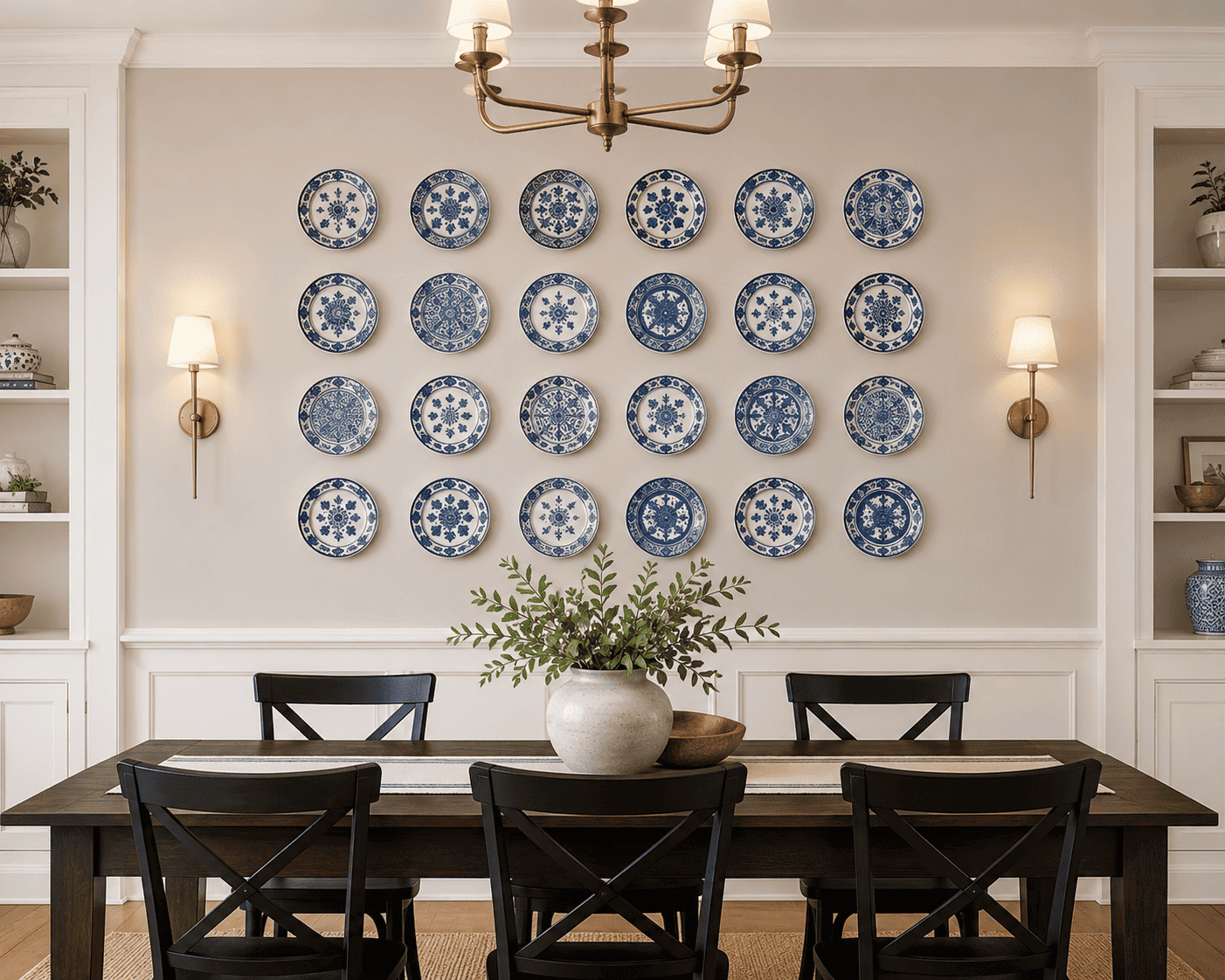
Rows and columns of matching or same-sized plates, spaced identically in every direction. It’s the easiest layout to get right on a first attempt because the grid itself does the visual work, and it reads as intentional even with mismatched patterns as long as the sizing and spacing stay consistent.
Circular (Sunburst) Arrangement
Needs planning

One large plate anchors the center, with smaller plates radiating outward to form a circle or sunburst shape. Mark the center point and use a piece of string as a makeshift compass to pencil a light guide circle before you start, since eyeballing a large circle almost always drifts off-round by the time you reach the far side.
Asymmetrical Organic Cluster
Beginner-friendly

A loose, uneven grouping that leans heavier to one side rather than centering evenly. This is the layout to reach for on a wall interrupted by a window, doorway, or light switch, since it doesn’t depend on a clean, uninterrupted rectangle the way a grid or circle does.
Vertical Column for a Narrow Wall
Beginner-friendly

A single stacked line of plates running top to bottom, sized slightly larger at the bottom and smaller toward the top. It’s the single best layout for the narrow strip of wall between a window and a cabinet, a space too tight for almost any other arrangement on this list.
Horizontal Row Above Furniture
Beginner-friendly

A single straight line of plates centered over a buffet, console, or headboard. Align every plate along its vertical center line, not its top or bottom edge, since plates of different diameters will look crooked if you align them by the edge instead.
Blue and White Transferware Wall
Timeless

Classic blue-and-white china, whether genuine transferware, Delft-style, or modern reproductions, in a loose grouping of mixed sizes. It’s close to foolproof because the color story does the unifying work even when the individual patterns, florals, landscapes, willow patterns, don’t match at all.
Monochromatic White-on-White Wall
Modern

All-white plates and platters that lean on shape and texture instead of color: scalloped edges next to smooth rims, round plates next to ovals. This works particularly well against a colored or beadboard wall, where the white ceramics read as sculptural rather than blending into a white wall behind them.
Color Gradient (Ombré) Wall
Needs planning

Plates arranged to shift gradually from a dark shade to a light one (or the reverse) across the wall, most often in a single color family like blue or green. Photograph your plates in a single row on the floor before buying more, since a gradient that looks smooth in a store often reveals awkward jumps once it’s next to its neighbors on the actual wall.
Mismatched Vintage Collector’s Wall
Grows over time

No color rule, no size rule, just whatever genuinely interesting pieces you’ve found at thrift stores, estate sales, or inherited over the years. Leave real breathing room around the current edges of the group rather than filling the wall completely, so the collection has somewhere to grow as you find more.
Oversized Statement Platter
Weight matters

One large decorative platter, hung alone or with only one or two small plates nearby, doing the work of an entire gallery wall by itself. This is the layout where hanger weight actually matters most on this list, see the hanging section further down before you buy the hardware.
Plates Framing a Mirror
Beginner-friendly

Plates arranged in a ring, arc, or symmetrical pair around a central mirror. Hang the mirror first, on a stud if it’s heavy, then work outward from the top and bottom so the plates stay balanced on both sides as you add them.
Plates Mixed With Framed Art
Gallery-style

Round plates tucked into the gaps between rectangular frames on an otherwise standard gallery wall. The round shapes soften all the hard right angles of a typical frame grouping, and a shared color palette between the art and the plates is what keeps the mix from feeling random.
Plates Mixed With Woven Baskets
Boho

Glazed ceramic plates alternated with flat woven baskets, pairing the shine of ceramic against matte, textured fiber. Baskets are lighter than plates, so they can go up with small finishing nails rather than the heavier-duty hangers the ceramics need.
Layered Plate Rack Display
No hangers needed

Plates set into a wall-mounted wooden plate rack or shelf rather than hung individually, allowing you to layer smaller items like teacups or jugs in front. It’s the easiest style on this list to update seasonally, since nothing is actually mounted to the wall except the rack itself.
Floor-to-Ceiling Statement Wall
Big commitment

A dense arrangement covering an entire vertical section of wall from baseboard to ceiling, mixing shapes and sizes to fill in every gap. Reserve your most durable or least expensive plates for the bottom rows, since that’s the area most likely to get bumped by furniture or foot traffic.
Staircase Plate Wall
Needs planning

Plates following the diagonal rake of a staircase, largest at the bottom and smallest toward the top, so the arrangement climbs with you. Lay the group out on the floor at an angle first to work out the spacing, and use hangers rated for extra security here since a staircase wall takes more vibration from foot traffic than a still wall does.
Dining Room Buffet Wall
Beginner-friendly

A grid, row, or cluster centered directly above a buffet or sideboard, sized to roughly match the furniture’s width. Coordinating the plate colors with a table runner or the room’s existing palette is what makes this feel architectural rather than added on as an afterthought.
Kitchen Breakfast Nook Display
Casual

A small, tightly-spaced grouping mounted just above a banquette or bench, low enough to feel cozy rather than formal. Fruit motifs, stripes, and simple hand-painted patterns tend to suit this spot better than delicate fine china, since it’s a lived-in corner rather than a display case.
Entryway Console Display
Beginner-friendly

A small, punchy grouping of 3 to 5 bold plates above a console table, meant to set the tone the moment someone walks in. Center the group about 6 to 8 inches above the tabletop so it reads as connected to the furniture rather than floating awkwardly high on the wall.
Seasonal Swappable Plate Wall
Low commitment

A fixed grid of hangers, left permanently mounted, with the plates themselves swapped out for the seasons or holidays. This is the one idea on this list built specifically to solve the “I’ll get bored of this” problem: once the hangers are up, changing the whole look takes minutes instead of a fresh round of measuring and hanging.
How to Arrange Decorative Plates Beautifully
Three rules cover most of what separates a plate wall that looks curated from one that looks cluttered:
Lay the full arrangement out on the floor, or trace each plate onto paper and tape the cutouts to the wall, before a single nail goes in. This is the single most repeated piece of advice across every real plate-wall project for a reason: it catches spacing problems while they cost nothing to fix.
That range reads as a unified collection rather than either a cramped cluster or a scattered handful of unrelated plates. Wider spacing, 8 inches or more, is its own deliberate look for a minimal, airy arrangement, but it needs to be consistent across the whole wall to look intentional.
For most layouts, the vertical center of the arrangement should land around 57 to 60 inches from the floor, the standard eye-level height used for gallery walls generally. Above furniture, center on the furniture instead and let eye level be a secondary check.
DIY Plate Wall Ideas on a Budget
A plate wall is one of the least expensive ways to fill a large wall, especially compared to an equivalent amount of framed art. Thrift stores, flea markets, and estate sales are the cheapest sources for individual pieces, often under $5 each, and restaurant supply stores sell bulk sets of plain white plates at a fraction of retail decor prices if you want a matching grid without the hunting. For new pieces, Hobby Lobby, HomeGoods, and Target carry inexpensive seasonal and solid-color plates, IKEA is a reliable source for affordable modern shapes, and Anthropologie, Etsy, and Pottery Barn or West Elm are better starting points if you want artisan or higher-end pieces as the anchor of the wall. Crate & Barrel and Williams Sonoma are worth checking for simple, well-made white plates that work especially well in a monochromatic or grid layout, and Wayfair is a reasonable source for hanger hardware in bulk if you’re outfitting a large wall at once.
Modern vs. Vintage Plate Wall Styles
| Factor | Modern | Vintage |
|---|---|---|
| Plate sourcing | New, matching sets | Thrifted, estate sales, inherited |
| Color approach | Monochrome or tight palette | Mixed patterns, often blue and white |
| Layout | Grid, column, or row | Circle, cluster, or organic collection |
| Cost | Predictable, buy once | Cheaper per piece, grows over time |
| Best for | Minimalist, Scandinavian, contemporary rooms | Farmhouse, cottagecore, traditional rooms |
How to Hang Decorative Plates Safely
This is the part most plate wall guides skip, and it’s the difference between a display that stays up and one that ends up in pieces on the floor.
| Plate size / weight | Recommended hanger | Typical rating |
|---|---|---|
| Under 4″ | Small adhesive disc | Up to 1 lb |
| 4″-8″ | Medium adhesive disc | 1-3 lbs |
| 10″-12″ | Large adhesive disc | Up to 5 lbs |
| Large plates / platters | XL adhesive disc, or two discs joined by wire | Up to 7 lbs per disc |
| 7″-11″ standard dinner plates | Wire spring hanger | 2-30 lbs depending on gauge and quality |
| Heavy platters, stoneware | Wire hanger into a wall anchor or stud | Rate for at least double the plate’s actual weight |
A few things worth knowing before you buy hardware: adhesive disc hangers give the cleanest, most invisible look and work best on smooth, glazed surfaces, but they’re difficult to remove cleanly once mounted, so they suit plates you don’t plan to take down often. Wire spring hangers are more secure for anything on the heavier end and are simple to reposition, but the metal claws show slightly at the plate’s edges unless you match the wire finish to the plate color. Whatever hanger you choose, weigh a stack of the actual plates you’re hanging rather than guessing, manufacturer weight ratings are typically conservative, but exceeding them is still the most common reason a plate wall fails.
Common Plate Wall Decorating Mistakes
Skipping the floor-layout or paper-template step is the single biggest reason people end up with extra nail holes and a lopsided final arrangement.
A hanger rated for 2 lbs holding a 4 lb platter is a matter of when, not if, it fails. Always weigh the plate and round up on the hanger rating.
Mixing 2-inch gaps in one section with 6-inch gaps in another is the fastest way to make an otherwise good collection look unplanned.
Plates with different rim depths sit at different distances from the wall, which is subtle in person but reads as misaligned in photos. Check depth, not just diameter, when matching pieces.
Wildly different colors, patterns, and shapes with nothing tying them together reads as random rather than curated. Pick one consistent element, color, era, or shape, to anchor a mixed group.
Tips for Maintaining Decorative Wall Plates
Plates mounted on a wall collect dust faster than plates in a cabinet, since they’re fully exposed on both display and back.
A quick wipe with rubbing alcohol removes oils and residue that weaken the adhesive bond over time.
Spring-loaded wire hangers lose tension gradually with age. A quick annual check catches a loosening hanger before a plate falls.
A hallway with heavy foot traffic vibrates more than people expect, which matters more for fragile antique glazes than for sturdy modern stoneware.
Plate Wall vs. Gallery Wall
A plate wall is really a specific type of gallery wall, built entirely or mostly from plates instead of framed art. The practical differences come down to cost and texture: plates are generally cheaper per piece than framed prints, especially thrifted, and they add three-dimensional depth and shadow that a flat framed piece can’t. Framed art offers more control over exact color and subject matter, since you’re choosing the image itself rather than working with whatever pattern a plate happens to have. Most rooms don’t need to choose one over the other. The mixed approach, plates tucked between frames, borrows the strengths of both.
Frequently Asked Questions
How do you hang decorative plates on a wall?
Small, light plates go up cleanly on adhesive disc hangers sized to the plate’s diameter. Standard 7 to 11 inch plates typically use a wire spring hanger with rubber-tipped prongs that grip the rim. Anything large or heavy should go into a wall anchor or stud rather than relying on adhesive alone.
What is the best layout for a plate wall?
There isn’t one universal best layout, it depends on the wall. A symmetrical grid is the easiest for a first attempt and works well on large, uninterrupted walls. An asymmetrical cluster is more forgiving on a wall with windows, doors, or other obstacles in the way.
Can you hang plates without nails?
Yes, for lighter plates. Adhesive disc hangers and Command-style strips both work without nails, though they carry lower weight limits than wire hangers on nails or wall anchors, so they suit smaller and lighter plates better than large platters.
How many plates should be on a plate wall?
Anywhere from 3 to 20 or more, depending on wall size and layout. A small entryway grouping works well with 3 to 5 plates, while a floor-to-ceiling statement wall can use 20 or more. Match the count to the wall’s actual size rather than a fixed number.
Which rooms are best for a plate wall?
Dining rooms and kitchens are the traditional choice since the plates feel thematically at home there, but entryways, hallways, staircases, and even bedrooms all work well, especially for softer, botanical, or pastel plate styles.
Are decorative plate walls still in style?
Yes. Plate walls have had sustained popularity as part of the broader grandmillennial and collected-vintage decor trend, and modern minimalist versions, monochrome grids and sculptural shapes, keep the concept relevant in contemporary rooms too.
How do you arrange plates of different sizes?
Anchor the arrangement with the largest plate first, usually centered, then work outward with progressively smaller pieces. Align plates by their vertical or horizontal center point rather than their edges, since edge-aligning plates of different diameters looks crooked.
What type of plates work best for wall decor?
Ceramic and porcelain plates are the most common choices and hold up well to standard hangers. Handmade pottery tends to run thicker, so measure rim depth before choosing hardware. Melamine and other plastic decorative plates are lighter and easier to hang but read as less substantial up close.
Can vintage plates be used for wall decorations?
Yes, and they’re one of the most popular choices for this exact purpose. Check the weight and condition of older china before choosing hardware, since antique glazes and gold rims can be more delicate than modern stoneware.
How do you clean decorative wall plates?
Dust regularly with a dry microfiber cloth. For a deeper clean, remove the plate if possible and wash with mild soap and water, then dry completely before remounting, especially if it’s going back onto an adhesive hanger.
Final Thoughts
Start with a layout that matches your actual wall, not the one that looked best in a photo. A narrow strip between a window and a cabinet wants a vertical column, not a circle; a wide dining room wall can handle a full grid or an organic cluster that a hallway can’t. Plan it on the floor before you touch the wall, match the hanger to the real weight of the plate, and the rest, color story, pattern mixing, vintage versus modern, comes down to taste rather than risk.
Leave a Reply